

Who knows what, and since when
Keep track of which secrets each character knows and since when, when the reader finds out, and let Exaratio warn you when something doesn't fit. · 4 min read
In a story, who knows what matters: the secret only one character knows, the rumor another believes, the truth the reader discovers at the end. Exaratio keeps track of it with facts and with what each character knows about them.
Facts
A fact is a sentence that can be known or not known: “Odren Mabri is alive and lives in the Broken Lighthouse.”
Open Review → Who knows what and click New fact to write one. Once the work has facts, “Who knows what” also opens from the chronology, with Who knows what.
Click a fact's statement to fill it in:
- In the world of the work, it is: true, one version, a rumor or a lie.
- Who or what it is about: the characters, places or objects it's about.
- True since: left blank, it has always been so.
- The reader finds out in: the chapter where it's told. If you haven't written it yet, check It must be told before the end and the fact will carry the yet to be told mark until you tell it.
To delete a fact, click the × next to its statement.
The “Who knows what” matrix
Each column is a fact and each row, a character who knows something. A filled cell means that character knows it: hover over it to see how they hold it, how they found out and since when.
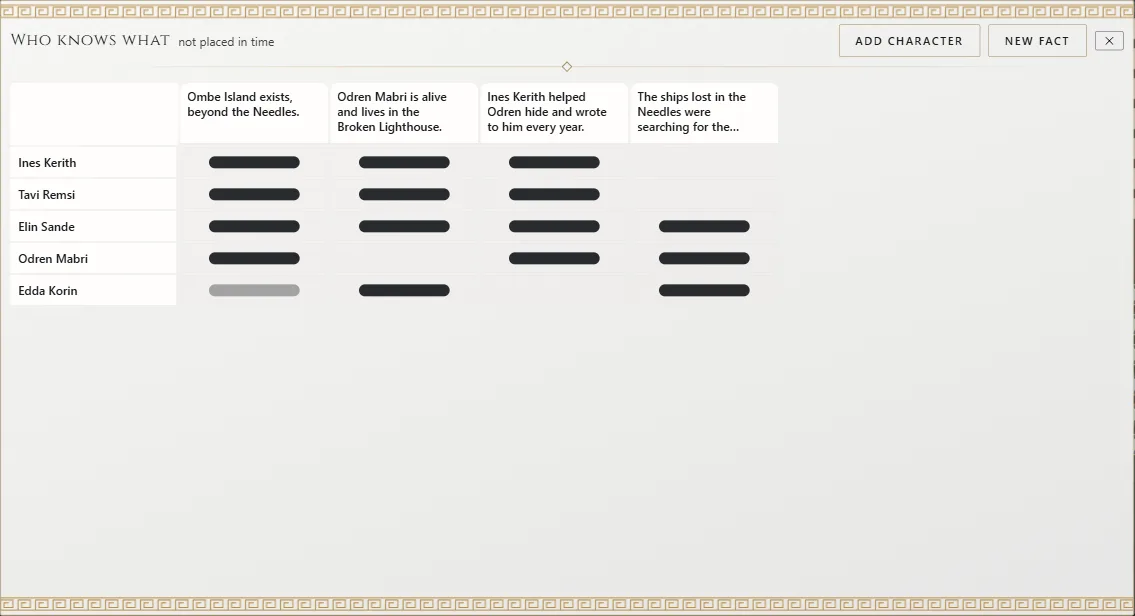
To give something they know to a character who isn't in the matrix yet, click Add character, then choose the character and the fact.
Click a cell to change:
- Holds it as: true, one version, a rumor, a lie, or that they believe it isn't so.
- Found out: they witnessed it, were told, worked it out or read it.
- Dates and scene: Knows it since, Forgets it or stops believing it and Found out in the scene. Dates are written as in the rest of the work, and Exaratio tells you how it understands them.
- No longer knows it.
When you say where a fact is told, Exaratio infers that whoever is in that scene knows it. What's inferred shows dotted: click Make it mine to confirm it; if you change it, it also becomes yours.
If you move the chronology to another date, the matrix shows what was known at that moment. Everything you change here can be undone with Ctrl+Z⌘Z.
On the character's sheet
On each character's sheet, What they know shows what they know in the scene you're writing, and Does not know yet what they'll discover later on. That way you write each line of dialogue knowing what they can say.
The sheet also warns you when a character believes a lie, and if the reader already knows something the character doesn't know yet, or the other way around. On a place's or an object's sheet you see what is known about it and who knows it.
Continuity warnings
Exaratio compares what you've noted down and warns you when something doesn't fit: someone who witnessed a scene they're not in, a character who appears before they're born, a relationship between two who never overlap in time.
Open them in Review → Warnings. Each warning has:
- Go: takes you to what causes it.
- Dismiss: if it's intentional.
- Resolved: when you've already fixed it. If it shows up again with different details, it reopens on its own.
You can reopen a dismissed warning whenever you like, with Warn again. More in Continuity warnings and how to resolve them.
You also see them while you write, in In the scene: click It's intentional if it's what you meant.
Exaratio 0.9 · revision 2 · October 17, 2026